EV Charging in Multi-Unit Buildings: Plan the Electrical Capacity First
Residents want to charge at home, and many municipalities now require it in new buildings. The cost depends less on the chargers than on how the building shares its electrical capacity.
Blog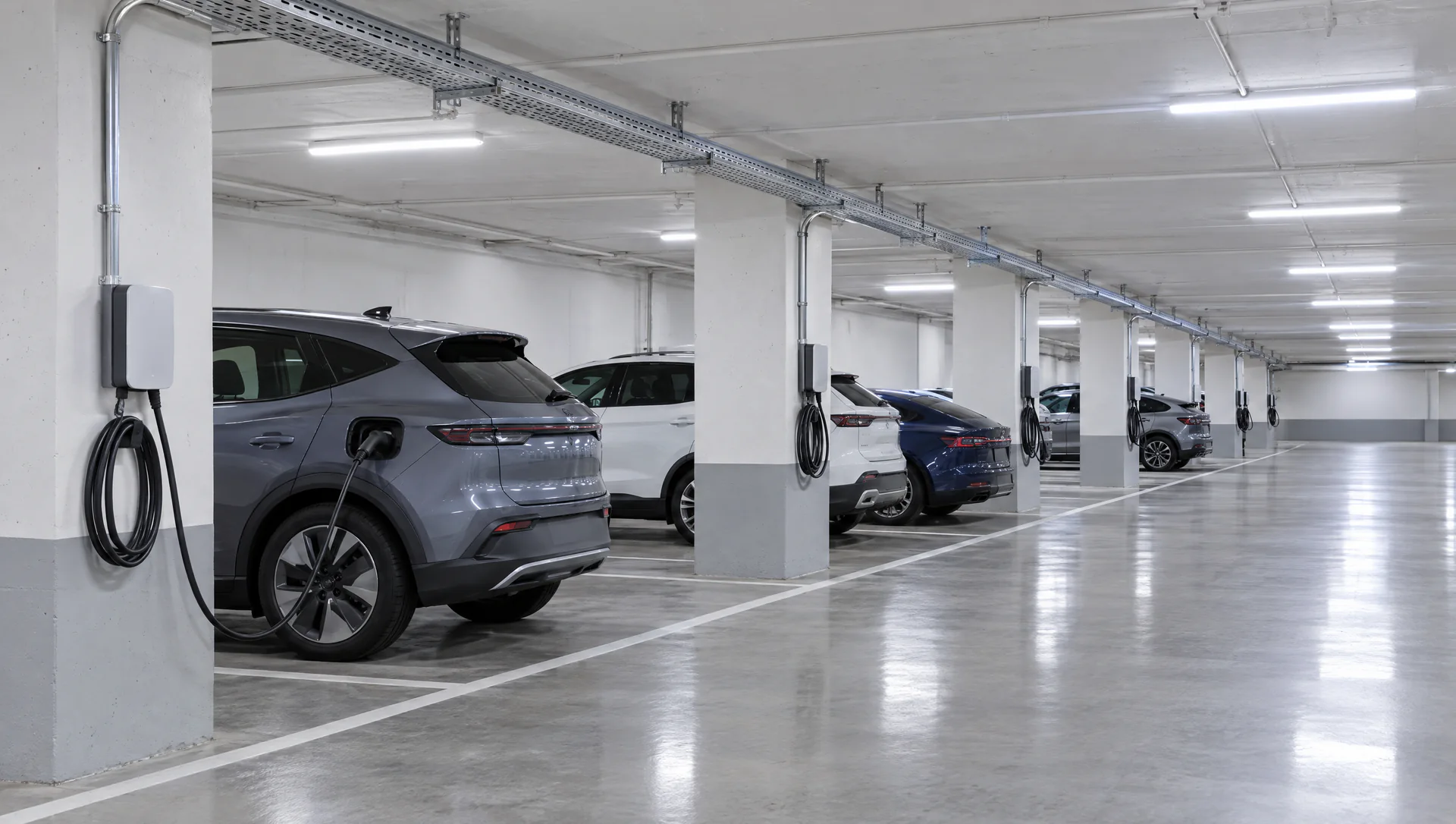
Most electric vehicle charging happens at home, overnight. For people who live in apartments and condominiums, home means a shared parkade and a shared electrical service. Getting charging right in a multi-unit residential building is mainly a question of electrical capacity, and the decisions that matter most are made long before the first charger goes on the wall.
Why the parkade is an electrical problem
A Level 2 charger on a 40 A circuit draws up to 32 A continuously, about 7.7 kW at 240 V. Multiply that by every stall in a 200-stall parkade and the theoretical load exceeds what many entire buildings use. No owner wants to pay for, and few utilities want to supply, a service sized for every car charging at full power at once.
Cars rarely need that. A car parked for ten hours overnight can recover a typical day's driving at a fraction of a charger's full output. The engineering task is to share capacity intelligently instead of building it for a peak that never comes.
A note on 208 volts
Many Canadian apartment buildings have 120/208 V three-phase services, not the 120/240 V of a house. Level 2 chargers work on 208 V, but at the same current they deliver about 13 percent less power. That is not a problem; it simply belongs in the calculations, so that nobody promises residents charging speeds the building cannot provide.
Energy management: the key that unlocks capacity
An electric vehicle energy management system (EVEMS) monitors and controls charging so that the total never exceeds a set limit. The Canadian Electrical Code allows chargers controlled this way to be counted at the system's setting, rather than at every charger's full output. Approaches range from simple to sophisticated:
- Circuit sharing: two to four chargers share one circuit and take turns or split the current.
- Panel-level management: the chargers on a panel are throttled together to stay below a fixed limit.
- Building-level management: the system watches the whole building's demand and lets charging expand overnight, when the rest of the building is quiet.
The smarter the management, the more stalls a given amount of capacity can serve.
EV-ready is not the same as chargers installed
Many municipal requirements, including Vancouver's, now ask new residential buildings to provide an energized outlet capable of Level 2 charging at each residential stall. That is EV-ready: the wiring, protection and load management are in place, and a resident or the strata can add a charger later. It differs from:
- EV-capable: conduit and space reserved, but no wiring.
- EV-installed: a charger mounted and working.
In a new building, making every stall EV-ready usually costs far less during construction than retrofitting later, because conduit routes, panel space and the size of the electrical room are decided while they are still cheap to change.
Retrofitting an existing building
Existing buildings are often where demand is most urgent and constraints are tightest. A sound retrofit begins with:
- Establishing spare capacity. Where the code and the utility allow it, a year of measured peak-demand data gives a far more accurate picture than a theoretical calculation, and often shows more headroom than expected.
- Mapping the routes. Conduit from the electrical room to the parkade, space for new panels and fire-rated penetrations are frequently the real cost drivers.
- Choosing the management strategy and the phasing. A design that can serve every stall eventually, but is built out as residents ask for it, avoids both under-building and stranded investment.
- Settling ownership and billing. In a condominium, the board, the bylaws and how residents pay for the electricity they use need answers before a contractor starts.
Fire safety and layout
Parkades full of electric vehicles raise fair questions from fire departments, insurers and residents. Charger placement, clear access for firefighters, sprinkler coverage and a clearly marked way to cut power to the chargers are worth settling with the fire protection engineer and the authority having jurisdiction early in design, not at permit stage.
What to ask your engineer
- How much spare capacity does the existing or proposed service really have?
- Which energy management approach gives every stall a useful overnight charge?
- What charging speed can residents expect on a typical night, at 208 V?
- Where will panels and conduit go, and how will the system expand?
- What does the authority having jurisdiction expect for fire safety in the parkade?
Charging at home is fast becoming something residents expect rather than a luxury. Owners who plan the capacity first get a system that grows with demand. Those who start with the chargers often pay twice.