

.webp)








Civil Engineering
Civil Engineering that Makes the Rest of the Project Possible
Civil Engineering is Where the Project Meets the Ground
Civil engineering is the discipline that decides whether the rest of the project can happen at all. Before the building can get out of the ground, the site has to drain, the services have to connect, the grading has to make sense for access and accessibility, and the offsite infrastructure has to be approved by a municipal authority that has its own priorities and timelines. Get civil right and every other discipline gets its canvas. Get it wrong, and even the best architectural and structural work has to bend around the problems.
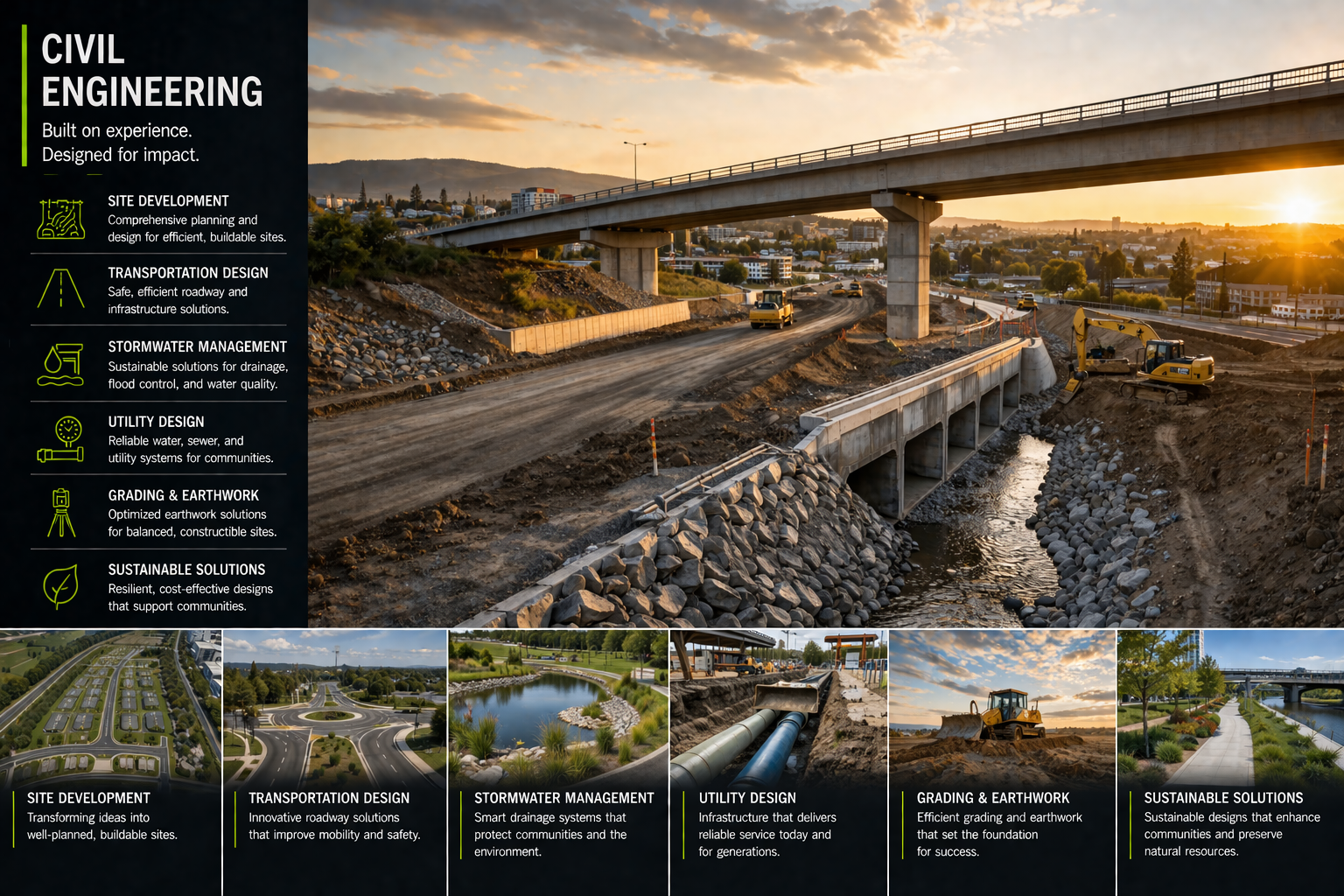
Our civil team designs site servicing, stormwater management, grading, and offsite infrastructure for commercial, institutional, industrial, and multi-family projects across our Canadian operating jurisdictions. We work on projects ranging from single-building infill sites on tight urban lots to multi-phase subdivisions and industrial parks with their own distribution networks.
Stormwater is the Civil Discipline's Hardest Problem
Stormwater management is where civil engineering is changing fastest. Municipal release rates are tightening. Green infrastructure (bioswales, permeable paving, constructed wetlands, rainwater harvesting) is moving from optional enhancement to permit requirement in more and more jurisdictions. Low-impact development (LID) criteria are being incorporated into Official Plans and subdivision agreements. We design stormwater systems that meet current jurisdictional rules while anticipating the direction those rules are moving, because a system that meets today's release rate by a hair is one that will be out of compliance the first time the municipality tightens its standards.
Offsite Engineering is the Real Project Risk
On-site civil is straightforward. Offsite civil is often where the project's actual schedule lives, because getting the water, sewer, storm, and roadway connections approved, built, and accepted by the municipality is rarely a fast-track exercise. We approach off-site engineering with explicit schedule discipline: early pre-consultation with the servicing authority, a documented understanding of what CCC and FAC acceptance requires in that specific jurisdiction, and a construction administration workflow that moves the municipal file through review at the pace the client's overall schedule can absorb.
Due Diligence Before the Land is Bought
Some of the most valuable civil engineering work happens before a client even owns the land. Preliminary grading, preliminary servicing, cut-and-fill analysis, and site-access reviews can surface dealbreakers, unbuildable grades, inadequate service capacity, access conflicts with the transportation authority, that would cost tens of millions to discover after closing. Our civil team routinely and quickly performs this kind of pre-acquisition due diligence, scaled to a due diligence budget rather than a full design fee.
Civil That Holds Up Through Approvals, Tender, and Construction
For architects and planners, our civil team coordinates site servicing, grading, and stormwater so the engineered site supports the urban-design intent rather than quietly overriding it. For developers, subdivision, commercial, and mixed-use servicing packages are sized and documented to move through municipal approvals predictably, with approvals managers who have taken your project type through your specific municipality before. For civil and servicing trade contractors, drawings are buildable, sediment-control plans are installable in the field, and the civil team stays on the file through commissioning when the soils or the elevations do not match the geotechnical report.
Scope of Services
- Subdivision and land development engineering: Full civil servicing design for residential, commercial, and industrial subdivisions, including plan development, municipal approval support, and coordination with land-development planning and surveying.
- Sanitary sewer design: Gravity sanitary collection, forcemains, pump stations, and connection-to-trunk design, with flow projections and capacity analysis.
- Stormwater sewer and conveyance design: Catchbasin and manhole sizing, storm-sewer network hydraulics, outfall design, and downstream capacity analysis.
- Stormwater management design reports: Quantity and quality control design to meet municipal release rates, regulatory agency targets, and low-impact-development criteria, with modelling to justify every sizing decision.
- Watermain design: Potable distribution design, hydraulic modelling for fire flow and pressure, and coordination with municipal water-supply authorities.
- Site grading and earthworks: Rough and detailed grading plans, cut-and-fill balancing, slope analysis, erosion-prone-area identification, and accessibility-compliant surface design.
- Site plan development: Full site plan packages for municipal site-plan-approval processes, with circulation, parking, loading, emergency access, and barrier-free route design integrated into the civil drawings.
- Servicing reports and analysis: Formal capacity reports for municipal application, including upstream and downstream infrastructure reviews, with recommendations when existing capacity is insufficient.
- Rezoning application support: Civil engineering input to rezoning and Official Plan amendment applications, including servicing feasibility confirmation and traffic-and-access commentary.
- Erosion and sediment control design: ESC plans, sequence-of-construction drawings, inspection and reporting protocols, and coordination with contractor field compliance.
- Preliminary design for land acquisition due diligence: Conceptual grading, servicing, cut-fill, and site-access analysis to support land-purchase go/no-go decisions before substantial capital is committed.
- Site access design and review: Driveway, intersection, and loading-access design, with coordination to the municipal transportation authority and, where warranted, formal traffic-impact studies.
- Offsite engineering design: Water, sewer, storm, and roadway infrastructure outside the project's property line, with municipal approvals workflow management.
- Construction completion certificate (CCC) and final acceptance certificate (FAC) documentation: As-built review, deficiency resolution, and municipal sign-off coordination through CCC and FAC.
- Low-impact development (LID) design: Bioswales, permeable paving, rainwater harvesting, and constructed infiltration systems, coordinated with the landscape and architectural teams.
- Coordination with structural, mechanical, and electrical teams: Servicing entry-point coordination, mechanical-room plumbing tie-ins, and electrical site-distribution coordination delivered as a single engineered package rather than siloed disciplines.
- Construction administration: Site reviews during construction, approval of contractor shop drawings and submittals, non-conformance tracking, and formal certification letters to the client and municipality.
Featured Projects

4 Mile Corner Plaza
.webp)

The Apartments At 500 River Heights

Boyle Renaissance Development - Phase II