

.webp)








Fire Protection
Fire Protection Systems Designed to Code, Designed for Reality
Fire Protection Engineering is Life Safety First
Fire protection design sits at the intersection of code compliance, insurance expectations, and emergency response reality. The codes (NFPA 13, NFPA 14, NFPA 20, the National Fire Code of Canada, and provincial adoptions) are tightly prescriptive, and they exist because every rule in them was written in response to a real fire that killed real people. We take that seriously. Our fire-protection designs comply with the code as written, not the way we'd prefer it were written.
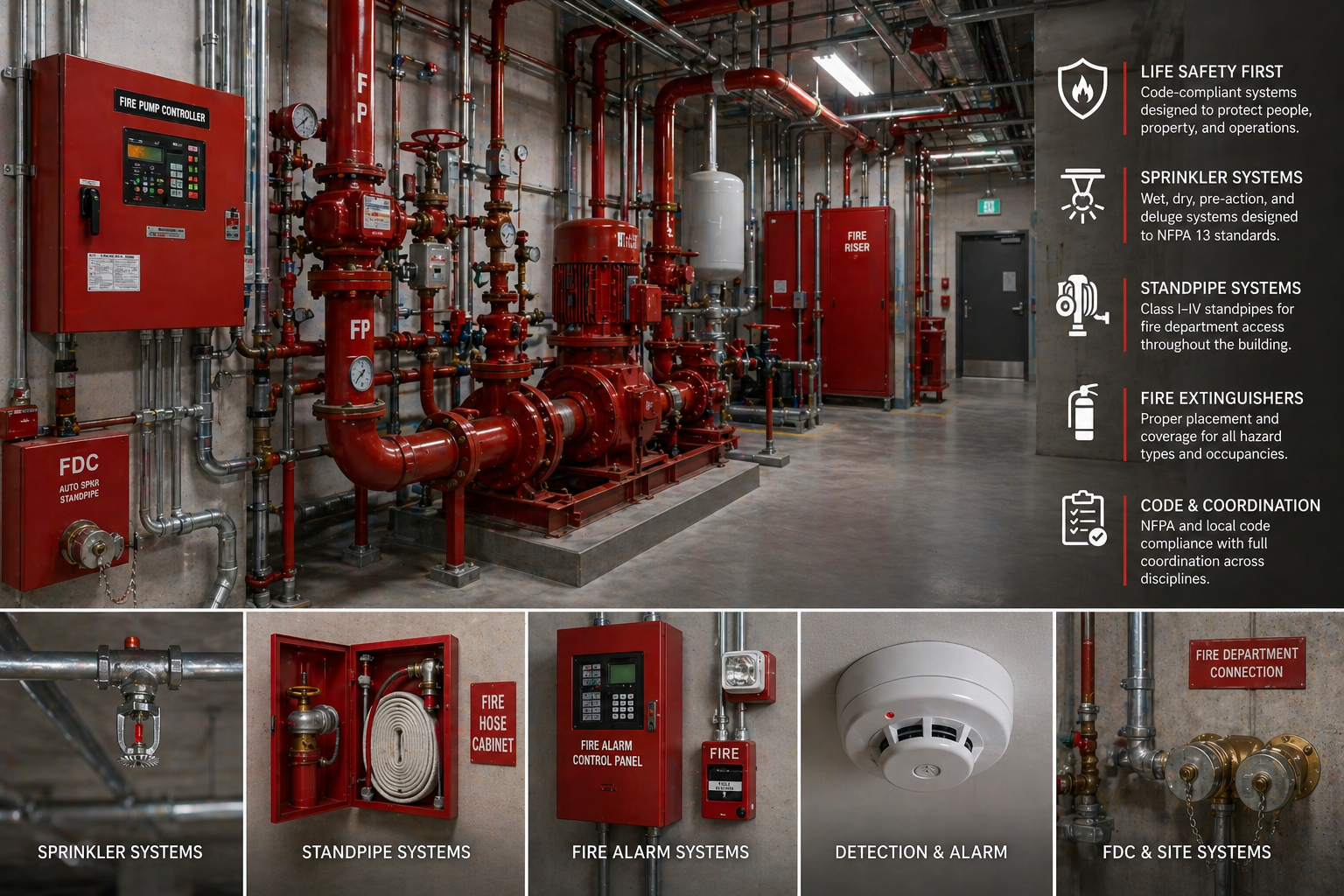
DWE provides sprinkler, standpipe, and fire-pump design for commercial, institutional, industrial, and multi-family buildings. Our hydraulic calculations, system layouts, and specification documentation are structured to satisfy the fire-safety plan, the authority-having-jurisdiction's submission format, and the building insurer's installation requirements simultaneously, not sequentially.
Coordination with the Mechanical, Structural, and Architectural Teams
Fire-protection coordination is where conflicts arise in real-world projects. Sprinkler mains routed through structural beams. Fire-pump rooms without an adequate domestic water supply. Specialty clean-agent systems that conflict with the mechanical ventilation sequence. Riser penetrations that compromise the rated assembly. Because our fire-protection designers work alongside our mechanical, structural, and architectural teams, those conflicts are designed out, not discovered during rough-in.
Specialty Suppression and High-Challenge Occupancies
Not every building gets adequate protection from conventional wet-pipe sprinklers. Data centres, clean rooms, high-value storage, cold-storage freezers, and certain industrial occupancies require specialty systems, clean-agent (FM-200, Novec, Inergen), pre-action, dry-pipe, and specialty water-based alternatives. We design those systems when they're the right answer, and we decline to specify them when a simpler system does the job safely and at lower cost. The right answer depends on the occupancy, the insurance carrier, and the owner's operations tolerance for inadvertent discharge, not on default specification habits.
Existing Building Retrofit
Retrofitting sprinkler and standpipe systems into existing buildings is its own specialty. Record drawings are incomplete, structural members aren't where the original drawings suggest, and the existing water service may not support the required flow. Our retrofit practice begins with site investigation: hydrant flow tests, existing-system pressure surveys, and structural member location. From there, we design retrofits that work within the building's actual, measured conditions, not the conditions implied by the original drawings.
Fire Protection That Fits Inside the Architecture
For architects, our fire protection engineers design around exposed structure, atrium geometry, ceiling-height ambitions, and mass-timber systems, not against them. For developers, suppression sizing is correct the first time, with water-supply analysis tied to real municipal flow tests, so the incoming service is not rebuilt partway through the project. For fire protection trades and design-build teams, hydraulically calculated drawings are installable, submissions are AHJ-ready for the specific jurisdiction, and the design team understands the differences between CAN/ULC-S524 and NFPA 13 in practice because we have taken submissions through every Canadian AHJ our clients operate in.
Scope of Services
- Fully sprinklered building design: Complete sprinkler system design to NFPA 13, including hazard classification, sprinkler layouts, hydraulic calculations, and specification.
- Partially sprinklered designs: Selective sprinkler protection for occupancies where full sprinklering is not required, with code-compliant documentation of protected and unprotected areas.
- Sprinkler head layout and hydraulic calculation: Head spacing, area-of-application calculations, and computer-hydraulic analysis to confirm demand-versus-supply at the design point.
- Standpipe system design: Class I, II, and III standpipe design to NFPA 14, with pump sizing, zone division for tall buildings, and coordination with fire-department connection locations.
- Fire pump design: Electric and diesel fire-pump sizing, specification, and installation design to NFPA 20, including jockey-pump coordination and emergency-power interfaces.
- Dry sprinkler system design: Dry-pipe system design for unheated spaces, including air-maintenance, trip-time analysis, and drain-and-low-point provisions.
- Pre-action sprinkler systems: Single-interlock and double-interlock pre-action design for water-sensitive occupancies such as data centres, archives, and clean rooms.
- Clean-agent suppression systems: FM-200, Novec 1230, Inergen, and CO₂ system design for server rooms, data centres, electrical vaults, and high-value storage.
- Specialty water-based systems: Water mist, foam-water, and deluge system design for specific high-challenge occupancies.
- Hydrant flow testing: Field flow-testing of municipal hydrants to confirm available supply and inform hydraulic design assumptions.
- Fire service water-supply analysis: On-site storage, private main, and booster-pump analysis when the municipal supply is insufficient.
- Fire-protection retrofit design: Sprinkler, standpipe, and fire-pump retrofits in existing buildings, including site investigation and remediation of legacy-system deficiencies.
- Coordination with fire alarm and life-safety: Joint sprinkler-and-fire-alarm sequence design for waterflow monitoring, trouble supervision, and elevator recall, designed with the electrical team's fire-alarm engineer, not handed off in isolation.
- Code-compliance review: Independent review of fire-protection designs for owners, building officials, and insurers.
- Construction administration: Shop drawing review, site reviews, hydrostatic test witnessing, and AHJ inspection support through final acceptance.
Featured Projects

Dundalk House
.webp)

Stouffville Main Street Apartments

2880 Kingston Rd