

.webp)







Electrical Engineering
Power, Light, and Life-Safety Systems Designed as One Integrated Grid
Electrical Systems for a Changing Load Profile
The electrical load profile of a commercial building has changed more in the last five years than in the thirty before it. Heat-pump conversions are reshaping winter peak load. EV charging is adding capacity demand that didn't exist in the original service. On-site generation and battery storage are turning single-direction feeds into bidirectional ones. Designing electrical systems the way they were designed in 2019 isn't neutral; it's a decision to build in early obsolescence.
DWE's electrical team designs for the building's actual load profile in 2035, not the one the occupancy classification calls for today. We size services, plan spare capacity, and locate equipment rooms with explicit provision for the electrification retrofits, EV build-outs, and renewable interconnections our clients are already quietly planning.
From Land Development to Building Fit-out
Our electrical scope spans the full infrastructure chain, from municipal distribution design for new subdivisions and industrial parks, through primary and secondary service entry, to panelboards, lighting circuits, fire alarm systems, security systems, and specialty low-voltage systems within individual buildings. That vertical range matters: when a single firm designs both the land-development distribution and the building service that connects to it, the coordination gaps that usually exist between the offsite and onsite disciplines don't.
Life Safety is Not a Checklist
Fire alarm and emergency-power design in Canada is tightly prescriptive on paper and deeply context-dependent in practice. The Part 3 building code, CAN/ULC-S524 for fire alarm installation, CSA Z32 for essential electrical in healthcare, and the local AHJ's interpretation of all of them routinely disagree with each other at the margins. Our electrical engineers know where those disagreements are, which AHJs care about which interpretations, and how to design systems that satisfy all of them without overbuilding, the kind of judgment that only comes from repeatedly taking projects through code review and permit.
Coordination with the Mechanical and Structural Teams
Most major electrical conflicts in construction aren't electrical problems; they're coordination problems with mechanical (transformer heat rejection, heat-pump loads, VFDs) and structural (conduit routing through prestressed slabs, transformer pad bearing). Because our electrical, mechanical, and structural teams work on the same project simultaneously, conflicts are resolved in the model rather than on site.
Electrical That Arrives in the Shape You Need
For architect-led projects, our electrical team coordinates service rooms, conduit routing, and fixture placement inside your ceiling and spatial strategy from day one, so coordination issues do not surface at IFC. For developers, the electrical scope is sized for the load profile the building will actually carry across its hold period, with EV, heat-pump, and solar provisions that protect leaseability and refinancing value. For design-build teams and electrical trades, specifications match the product Canadian distributors actually stock, panel schedules pick up cleanly, and fire alarm packages are prepared the way local AHJs want them. Hence, the submission clears the first time, not the third.
Scope of Services
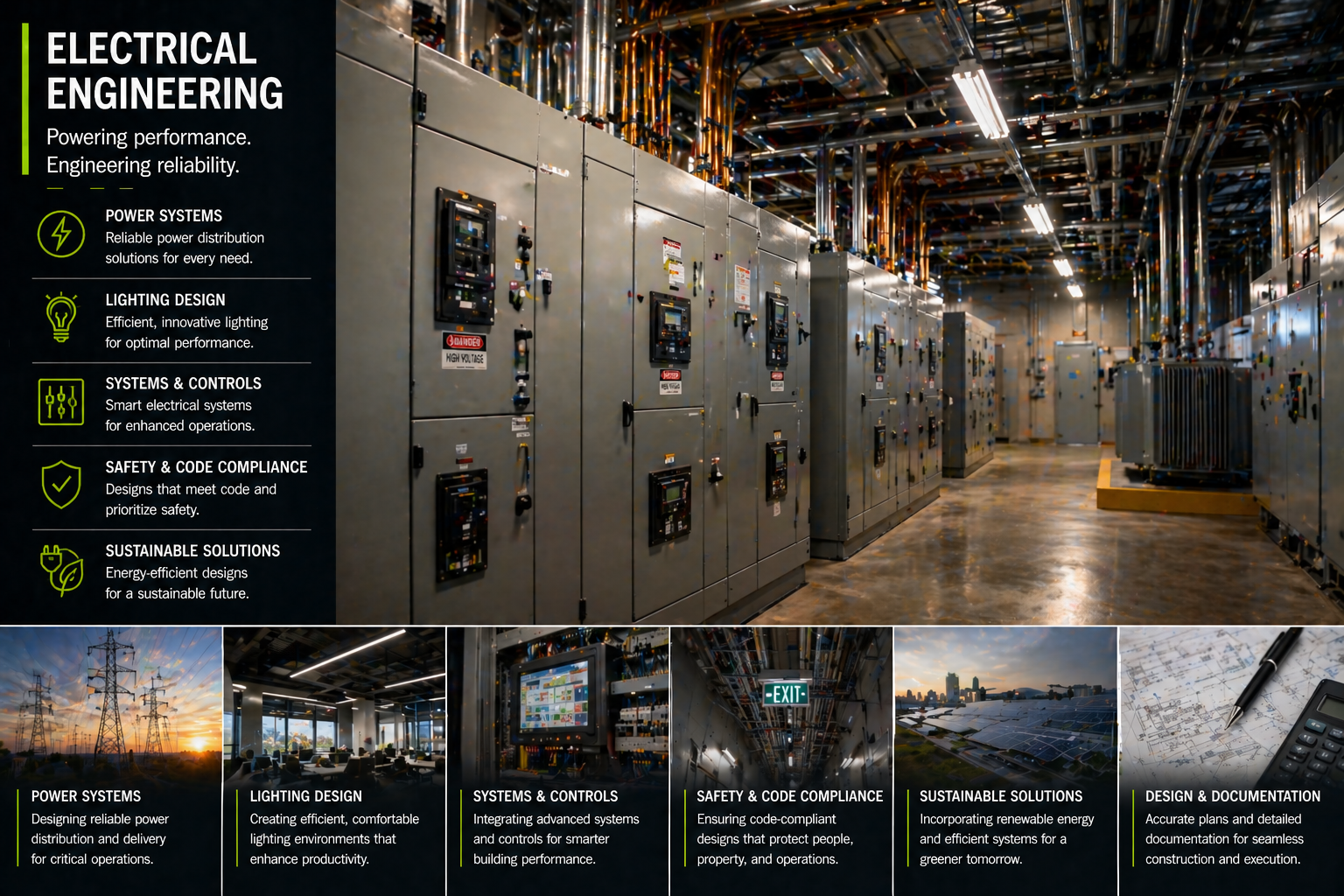
- Electrical service and distribution design: Service sizing, transformer selection, main switchboard and distribution-panel layouts, riser diagrams, and arc-flash-aware equipment coordination, for commercial, institutional, industrial, and multi-family projects.
- Load calculations and capacity planning: Connected and demand load calculations, spare-capacity provisioning, and service-size recommendations that anticipate electrification, EV, and solar additions over the building's life.
- Low, medium, and high voltage distribution: Design and specification of 120/208V, 347/600V, and medium-voltage distribution systems, with transformer selection, conductor sizing, and protective-device coordination.
- Standby and emergency power: Generator sizing, automatic-transfer-switch selection, paralleling schemes, and fuel-supply design, with code-compliant emergency lighting and life-safety branch circuits.
- UPS and critical power systems: Static and rotary UPS sizing, distribution to critical loads, bypass and maintenance schemes, and integration with generator systems for data, healthcare, and mission-critical applications.
- Fire alarm systems: End-to-end fire alarm design to CAN/ULC-S524, with device layouts, riser diagrams, voice-evacuation where required, integration with suppression and sprinkler monitoring, and AHJ-ready submission packages.
- Life-safety systems for healthcare: Essential electrical systems to CSA Z32, branch-circuit classification, redundancy, and emergency-power coordination for hospitals, long-term care, and clinics.
- Security and access control systems: Card access, CCTV, intrusion detection, intercom, and integrated security management systems, designed with the owner's IT and security teams, not independently.
- Communications and data distribution: Structured cabling, equipment-room design, pathway layouts, and coordination with telecom and data providers for office, institutional, and industrial occupancies.
- Building power distribution: Panel schedules, feeder design, grounding and bonding per CEC Section 10, receptacle and specialty-circuit layouts, and coordination with the mechanical team's VFD and heat-pump loads.
- Heat trace design: Electrical heat trace for piping, roof and gutter, and process applications in cold-climate projects, with control strategies and energy consumption analysis.
- EV charging infrastructure: Level 2 and DC fast-charge design for commercial, multi-family, and fleet applications, including load management, metering, and service capacity analysis for staged rollout.
- Solar PV and battery storage electrical: Interconnection design, inverter selection, service upgrade analysis, and coordination with utility interconnection requirements for commercial and institutional solar arrays.
- Subdivision and land-development electrical: Primary and secondary distribution design for new subdivisions, industrial parks, and mixed-use developments, coordinated with the civil servicing and land-development team.
- Lighting power and controls: Panel feeds, controls wiring, sensor networks, and dimming infrastructure coordinated with the lighting-design team's photometric work.
- Electrical audits and energy studies: ASHRAE Level 1, 2, and 3 audits with electrical-specific recommendations; power-quality investigations; and load-monitoring studies for retrofit planning.
- Grounding and bonding design: Building ground grids, equipment grounding, surge protection, and telecom-grade grounding for sensitive occupancies.
- Control room and process electrical: Motor control centres, VFD panels, instrumentation power, and control-room layouts for industrial and process facilities.
- Construction administration: Shop drawing review, site reviews, deficiency logs, and commissioning sign-off through substantial performance.
Featured Projects

Pauquachin First Nation Housing Complex
.webp)

Saje Natural Wellness

Four Points by Sheraton Vaughan