

.webp)





Lighting Design
Lighting Design that Performs Under Real Conditions, Not Just in the Renderings
Lighting Design is a Performance Discipline, Not a Decorative One
The market still treats lighting design as a specification exercise: pick a fixture, lay it out on a grid, and move on. Good lighting design is a performance discipline. The right lighting outcome depends on the geometry of the space, the age and visual demands of the occupants, the daylight contribution at different times of year, the controls strategy, the maintenance regime, and the owner's energy-cost priorities. Each of those factors pulls the design toward different fixtures, different layouts, and different controls. A good lighting engineer holds all of them in mind at once.
DWE's lighting team designs interior, exterior, site, and municipal lighting systems for projects across Canada. We use industry-standard photometric modelling tools. AGI32 and DIALux, to validate every design against measurable illuminance, uniformity, and glare targets before a single fixture is purchased. That means our designs land on the photometric requirements the standards demand, not the photometric assumptions a fixture's marketing materials promise.
Controls Matter as Much as Fixtures
For commercial and institutional projects, lighting controls now account for as much of the energy outcome as fixture selection. Occupancy and vacancy sensing, daylight harvesting, scheduled dimming, task tuning, and code-mandated automatic shut-off together can cut lighting energy use by 30 to 60 percent compared to a fixture-only approach. Our lighting designs specify controls end-to-end, sensor networks, control zones, dimming protocols, panel connections, and sequence-of-operations, coordinated with the electrical team's power distribution and the sustainability team's energy model.
Exterior and Municipal Lighting
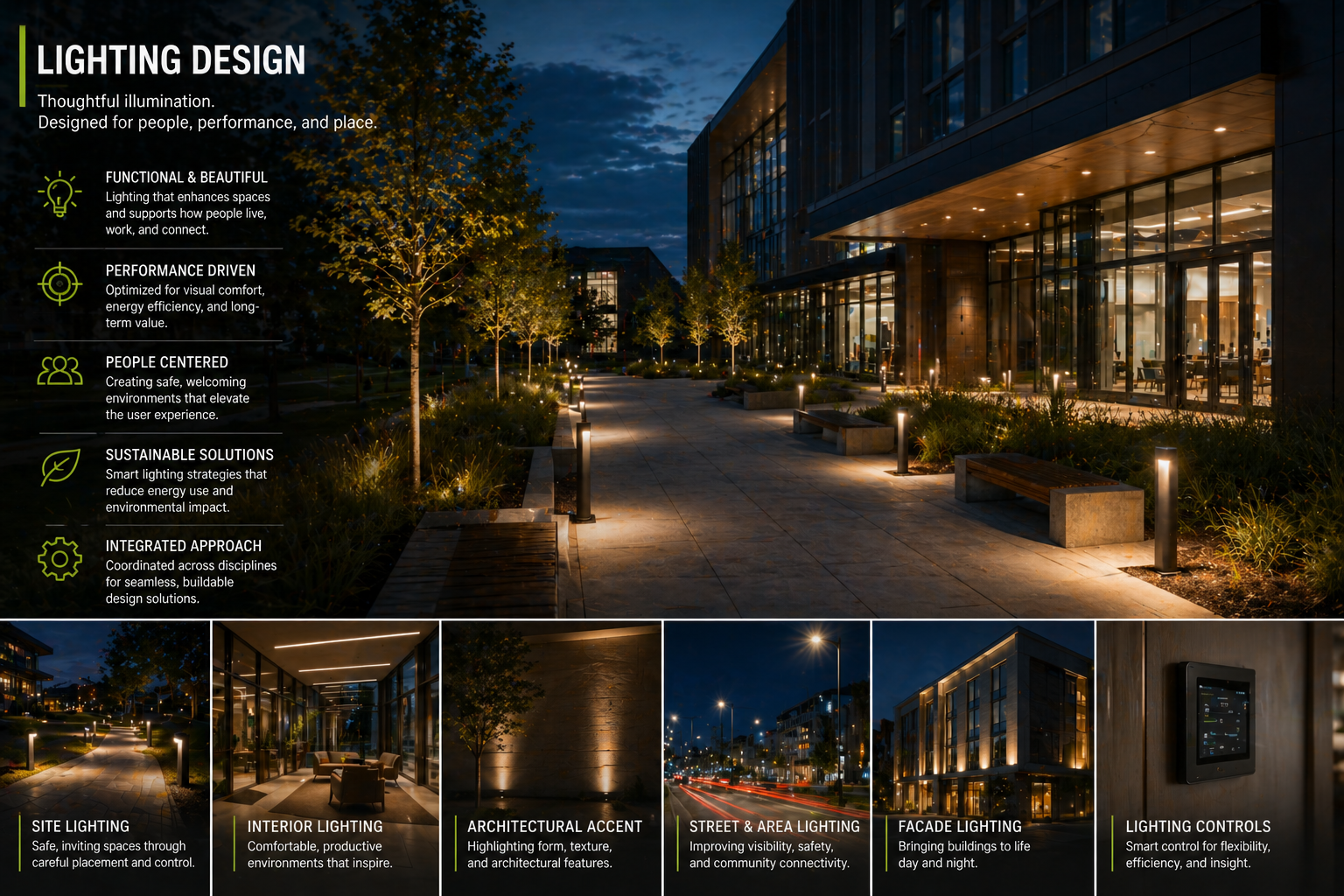
Exterior lighting is where light-pollution concerns, safety requirements, and energy targets collide most sharply. Dark-Sky-compliant fixture specification, BUG-rating analysis (backlight, uplight, glare), and photometric modelling of spill light into adjacent properties are no longer optional; they're standard expectations for site-plan approval in many Canadian jurisdictions. Our exterior and municipal lighting practice handles the photometric analysis, fixture specification, and controls strategy needed to meet those expectations while still delivering the safety and wayfinding outcomes the project actually requires.
Daylight-Aware Design
The biggest lever on lighting energy is daylight. A lighting design that assumes the artificial system carries the full load from 8 am to 6 pm is one that guarantees wasted energy. We coordinate with the Sustainable Design and Energy Modelling teams on daylight-autonomy analysis, which assesses whether the design actually receives useful daylight during occupied hours, and feed that analysis back into lighting controls, fixture placement, and dimming zones.
Lighting That Matches Your Design, Your Budget, and Your Install
For architects, our lighting studio works as a collaborator: layering, colour temperature, fixture discipline, and controls narrative executed as an extension of your design intent rather than a photometric plot handed back to you. For developers, fixture packages meet leasing and resale aesthetic expectations without overshooting budget, with an unbundled fixture scope that you can competitively bid or direct-purchase to protect margin. For electrical and controls trades, fixture schedules are still available at tender, controls narratives are programmable by the integrator you hire, and substitution reviews come back on the schedule the site actually runs on.
Scope of Services
- Interior lighting design: Photometric-modelled interior layouts for commercial, office, institutional, retail, hospitality, and residential projects, designed to task-specific illuminance, uniformity, and glare targets.
- Exterior and site lighting design: Parking area, walkway, loading, and facade lighting with BUG-rating and spill-light analysis to meet site-plan-approval expectations.
- Municipal and roadway lighting: Photometric design for street and municipal applications, including IESNA roadway-classification compliance, pole-and-luminaire selection, and integration with municipal control standards.
- Sports, recreation, and arena lighting: High-illuminance, high-uniformity, low-glare design for sports and recreation facilities, with broadcast-grade photometric validation where required.
- Healthcare and institutional lighting: Circadian-aware, task-appropriate, and infection-control-compatible lighting for hospitals, long-term care, and institutional occupancies.
- Dark Sky–responsible exterior specification: Fixture selection, shielding analysis, and controls strategy that meet Dark Sky or municipal light-pollution ordinances without compromising safety or wayfinding.
- Lighting controls design: Occupancy and vacancy sensing, daylight harvesting, task-tuning, scheduled dimming, and code-mandated automatic shut-off, zoned, sequenced, and specified end-to-end.
- Networked lighting controls (NLC): DALI, 0-10V, and IP-based networked-lighting-controls design, with commissioning specifications and integration with the building management system.
- Emergency and egress lighting: Unit-battery and central-inverter emergency lighting design to the National Building Code, with coordination to the electrical team's life-safety branch.
- Facade and architectural lighting: Linear, graze, and accent lighting for facade, signage, landscape, and feature-element applications, coordinated with the architectural design intent.
- Sustainable LED specification: Efficacy-driven fixture selection, TM-30 and CRI verification, and L70/L80/L90 lumen-maintenance analysis to protect the design intent through the full life of the installation.
- Photometric modelling and verification: AGI32 and DIALux modelling with field verification protocols for post-installation validation.
- Daylight-integrated design: Coordination with the Sustainable Design / Energy Modelling teams on daylight-autonomy modelling, so lighting control zones and dimming strategies track the real daylight contribution.
- Retrofit lighting design: LED conversion of existing fluorescent, HID, and incandescent systems, with payback analysis and utility-incentive documentation.
- Feasibility studies and owner workshops: Early-stage lighting feasibility, goal-setting sessions with ownership, and specification-strategy workshops.
- Construction administration: Shop drawing review, site reviews, commissioning and aiming support, and deficiency resolution through substantial performance.
Featured Projects

O’Connor Drive Mid-Rise
.webp)

Design Works Engineering - Grande Prairie

The Enclave