
.webp)






Sustainable Design
Mechanical, electrical, structural, civil, and lighting teams designing sustainable performance into every building from day one — and modelling it before the first shovel hits the ground.
Sustainability, Engineered from the Inside Out
At Design Works Engineering, sustainable design is not a separate practice or a bolt-on service. It lives inside our mechanical, electrical, structural, civil, and lighting teams, informing every decision from the first feasibility sketch to the final commissioning report. We believe environmentally responsible design should pay for itself — in reduced operating costs, improved occupant health, higher asset value, and long-term resilience — and our role is to make that payoff real, measurable, and defensible to the people writing the cheques.
The buildings our clients are commissioning today will still be operating in 2075. That means they need to perform under future energy codes, carbon pricing, climate conditions, and tenant expectations. Designing for that horizon takes more than good intentions. It takes the quantitative discipline to model performance before construction, the breadth to balance tradeoffs across every system, and the integration to make sure mechanical, electrical, structural, and envelope decisions are actually pulling in the same direction. That integration is the engine of everything we do.
One Team, One Model, Every Discipline
The single biggest source of waste in conventional sustainable design is the seam between disciplines. A mechanical engineer specifies a low-temperature heating system that the envelope can't support. A structural team changes the slab depth in a way that destroys the embodied carbon target. An electrical team adds plug loads that quietly undermine the Net Zero path the owner paid for. These conflicts surface late, get resolved under pressure, and the finished building ends up performing at 70 or 80 percent of what the original sustainability report promised.
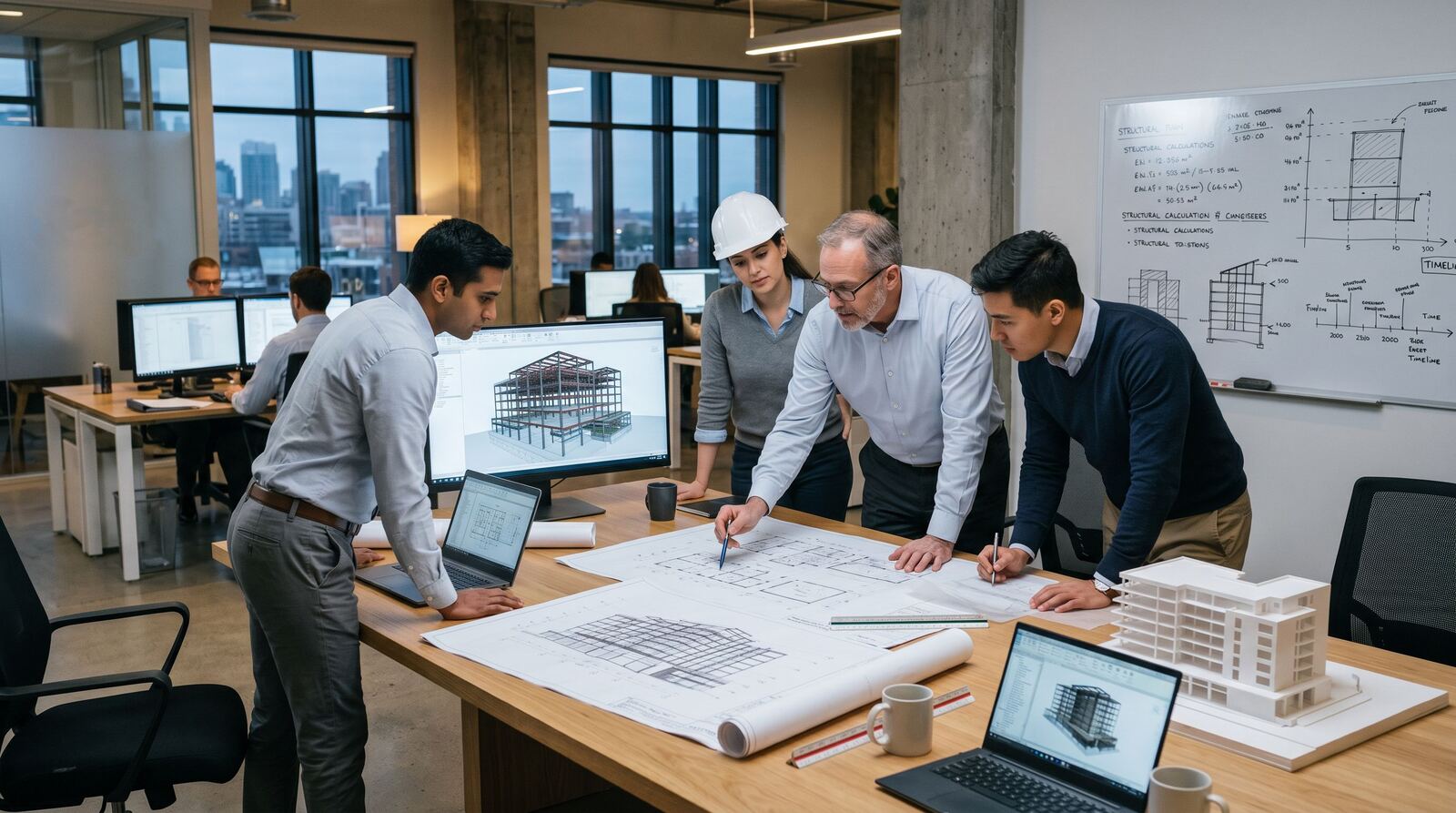
Because DWE houses mechanical, electrical, structural, civil, lighting, and energy modelling under one roof, we resolve conflicts during design, not after. Our in-house energy modeller works from the same base model as the MEP engineers. Our structural team is looped in the moment low-embodied-carbon concrete mixes are on the table. Our civil team designs site servicing with stormwater capture and renewable-ready infrastructure anticipated from the start. The result is a building that actually performs the way the drawings promised — not one that almost performed, if only the disciplines had been talking sooner.
Measured, not assumed, trade-offs across every system, and the integration to ensure the fastest-growing share of a building's lifetime impact, and the one LCA) of the structure and envelope, quantif, building a Net Zero case that has to stand up to a CFO and a lender,ying embodied carbon from cradle to grave and identifying the specific material substitutions that deliver the largest
Every sustainability target on a DWE project is backed by a model, a calculation, or a code citation — never a rule of thumb. Our in-house energy modelling team uses industry-standard tools to quantify building performance against both compliance pathways and certification pathways. We test envelope tradeoffs, HVAC configurations, glazing ratios, and renewable contributions against hard performance targets, and we surface the cost-per-tonne-of-carbon-saved for every option on the table. Our clients don't make sustainability decisions on vibes — they make them on numbers.
The Canadian Sustainability Toolkit
Our sustainability practice is grounded in the certification frameworks and compliance pathways that actually move the needle in the Canadian market. We deliver projects under:
- LEED v4 / v4.1 — Full certification support from Certified through Platinum across the BD+C, ID+C, and O+M rating systems — including energy modelling, materials documentation, and submission management, led by LEED APs on staff.
- Zero Carbon Building Standard (CaGBC) — ZCB-Design and ZCB-Performance pathways for new construction and existing buildings, including the zero carbon balance modelling, embodied carbon limits, and transition plans that the standard requires.
- Passive House (PHI / PHIUS) — PHPP and WUFI-based modelling to deliver projects against Passive House performance targets for space heating demand, airtightness, and primary energy use.
- CMHC MLI Select and MLI Flex — Full energy performance documentation to qualify multi-family and rental developments for CMHC's preferential mortgage insurance programs — a direct financial incentive most projects leave on the table because they can't produce the modelling evidence.
- National Energy Code for Buildings (NECB) — Performance-path compliance modelling, prescriptive-to-performance trade-off analysis, and municipal step-code support.
- ASHRAE 90.1 — Compliance and beyond-code modelling for projects benchmarked against ASHRAE-referenced performance goals.
Embodied Carbon and Lifecycle Thinking
Operating carbon gets most of the attention, but embodied carbon — the emissions locked into concrete, steel, insulation, and structural timber before a building is even occupied — is now the faster-growing share of a building's lifetime impact, and the share that building codes are starting to regulate. We conduct whole-building Life Cycle Assessments (LCA) on structure and envelope, quantifying embodied carbon from cradle to grave and identifying the specific material substitutions that deliver the biggest reductions. On a typical commercial project, that analysis can cut 20 to 40 percent of embodied emissions without compromising structural performance or cost — if it's done early enough, actually, to change the design.
Net Zero and Decarbonization Roadmaps
Net Zero is a target, not a design. Reaching it requires a roadmap — a sequenced set of envelope decisions, mechanical strategies, renewable contributions, and operational protocols that together close the energy and carbon gap. DWE develops those roadmaps at two scales:
- For individual buildings — Model pathways from the current design baseline to Net Zero Energy, Net Zero Carbon, or Net Zero Ready, with cost-per-option analysis and staged implementation plans that let owners invest in the right order rather than all at once.
- For existing portfolios — Rank assets by retrofit readiness, quantify the capital required to meet 2030 and 2050 emissions targets, and prioritize the interventions with the fastest payback — producing a roadmap that ownership can actually finance.
Sectors We Serve
Our Sustainable Design team applies these services across most major building types. We have particular depth in:
- Multi-family residential — market-rate, affordable, and CMHC-financed rental developments
- Commercial office and mixed-use
- Institutional and post-secondary
- Healthcare and long-term care
- Controlled-environment agriculture and indoor farming
- Industrial and warehouse
- Municipal and community facilities
- Retrofit and adaptive reuse of existing buildings
Why Design Works for Sustainable Design
Single-discipline sustainability consultants can tell you what to target. They can't tell you whether your mechanical, structural, and envelope teams can actually deliver it. DWE can — because those teams work here. Our LEED AP and our in-house energy modeller sit at the same table as the engineers designing the HVAC system, the structural frame, the lighting controls, and the site servicing. The result is sustainability advice that's not just ambitious, but buildable — and targets that survive contact with the construction schedule, the cost estimator, and the commissioning agent.
If you're weighing a LEED, Zero Carbon, or Passive House certification; building a Net Zero case that has to stand up to a CFO and a lender; or planning a decarbonization roadmap across a real estate portfolio — we'd like to hear the specifics.
Scope of Services
- Energy modelling for compliance — NECB, ASHRAE 90.1, and local step-code modelling, with full performance documentation for authorities having jurisdiction.
- Energy modelling for certification — Rigorous performance models for LEED, Zero Carbon Building Standard, and Passive House, including every certifying-body-specific workbook and submission deliverable.
- CMHC MLI Select and MLI Flex documentation — Complete energy-performance modelling and reporting packages required to secure CMHC's preferential mortgage insurance for multi-family and rental developments.
- Whole-Building Life Cycle Assessment (LCA) — Cradle-to-grave embodied carbon analysis across structural frame, envelope, and major finishes — with material-substitution scenarios quantified against cost and schedule impact.
- Net Zero feasibility studies — Pathway analysis from the baseline design to Net Zero Energy, Net Zero Carbon, or Net Zero Ready — with cost-per-tonne-of-carbon-saved for each strategy and a staged capital plan.
- Portfolio decarbonization roadmaps — Multi-asset retrofit sequencing aligned to 2030 and 2050 carbon targets, with prioritization logic, capital requirements, and utility-incentive leverage built in.
- Daylight and glare analysis — Illuminance, daylight factor, and glare modelling to optimize window placement, reduce artificial lighting load, and satisfy certification daylighting credits.
- Thermal comfort analysis — PMV / PPD modelling and advanced airflow studies to verify occupant comfort in complex, open-plan, or high-glazing spaces before construction commits.
- Renewable energy feasibility — solar PV — Sizing, roof-area optimization, interconnection analysis, financial payback modelling, and battery storage evaluation for commercial and institutional projects.
- Renewable energy feasibility — geothermal — Site-level thermal conductivity analysis, borefield sizing, and integrated ground-source heat pump system design.
- Envelope performance analysis — Hygrothermal and thermal-bridge modelling to optimize envelope performance, avoid condensation risk, and meet certification airtightness and R-value targets.
- Decarbonization of existing mechanical systems — Replacement planning that transitions gas-fired heating to electrified alternatives (air-source and water-source heat pumps, hydronic loops, VRF) with staged implementation to limit tenant disruption.
- Building electrification strategies — Load analysis, electrical service upgrade planning, and panel capacity modelling to support all-electric operation, future EV charging, and heat-pump conversions.
- Incentive and grant support — Verified energy-savings documentation to secure Greener Homes, Canada Infrastructure Bank, CMHC, SaskPower, Efficiency Alberta, Save On Energy, and other utility and government incentive programs.
- Owner education and sustainability workshops — Early-stage working sessions with ownership groups to set realistic targets, clarify certification tradeoffs, and align budgets with the desired performance level before design starts.
- Post-occupancy measurement and verification — Field M&V of actual building performance against the design model — closing the gap that routinely emerges between predicted and operational results and giving owners defensible evidence that their investment paid off.

Featured Projects
.jpg)
Essex Apartments and Executive Flats
.webp)

Fraser Brothers Roofing

Prologis Tapscott DC4