
.webp)







Structural Engineering
Structural Design that Survives Construction, Occupancy, and 50 Years of Change
Structure is the Commitment that Outlasts Everything Else
Finishes are replaced every 10 years. Mechanical equipment turns over every 20 years. Tenants, uses, and layouts change faster than either of them. The structural frame is the one system that remains the same 50 years after the ribbon is cut. That makes every structural decision a commitment, and the quality of the commitment depends on whether the engineer understood the loads the building would actually carry, not just the loads the original program specified.
DWE's structural team designs for the building's useful life, not the design life of the first occupancy. We pay particular attention to future modification: where openings might be cut for future tenant reconfigurations, how renewable loads on the roof will stack against snow and live loads over time, and how structural transparency (visible framing, legible load paths) will help or hinder the renovations that inevitably come.
Material-Agnostic Design
Concrete, steel, cross-laminated and glue-laminated timber, cold-formed and hot-rolled hybrids, the right structural system is the one that delivers the required performance at the best-available cost and carbon profile for the specific site, schedule, and market. We don't have a house material. Our team designs in concrete, steel, wood, and hybrid systems every year, and our specification reflects what the trade market in the region can actually deliver on schedule, not what a design handbook prefers.
Mass timber is a particularly good example. It earns its premium on certain projects, not on others, and the gap has more to do with labour markets, supplier access, and fire-rating constraints than with the inherent merits of the material. We price both options and show the client the real tradeoff, with embodied-carbon implications quantified where the project targets require it.
Seismic, Snow, Wind, and the Reality of Canadian Climate
Canadian structural design is unforgiving. The 2020 National Building Code updated seismic hazard values across most of the country. Snow loads in the Prairies and Atlantic provinces remain among the highest in the developed world. Climate-driven shifts in rain-on-snow events and high-wind exposure are pushing load combinations into territory that isn't yet fully reflected in code precedent. Our team works in accordance with the current National Building Code of Canada and provincial building codes. Where our clients are pursuing high-performance or resilience targets, we model loads against realistic future-climate scenarios rather than the historic record alone.
Renovation, Adaptive Reuse, and Damage Assessment
More than half of the structural work in our market is on buildings that already exist, renovations, additions, tenant reconfigurations, and damage assessments following fire, flood, vehicle impact, or long-deferred maintenance. Those projects are harder than new construction, not easier. They require site investigation, load-path reconstruction from incomplete record drawings, and temporary-support engineering that keeps the building standing while the work is done. Our structural team runs a dedicated renovation and assessment practice because that's what our clients actually need help with.
Structure Coordinated to Your Design, Your Schedule, and Your Trade Scope
Working alongside an architectural lead, our structural engineers design to your spans, your column-free bays, and your exposed-frame vision, and we flag the cost-consequential moves early enough that you can trade them off with real numbers in front of you. In developer-led programs, structural sizing is calibrated to the market product you are actually building, not to the most conservative assumption, so value engineering happens at schematic rather than in a panic at tender. On design-build and trade projects, drawings are sequenced to reflect how formwork, rebar, and steel erection actually occur, and structural RFIs come back in days rather than weeks.
Scope of Services
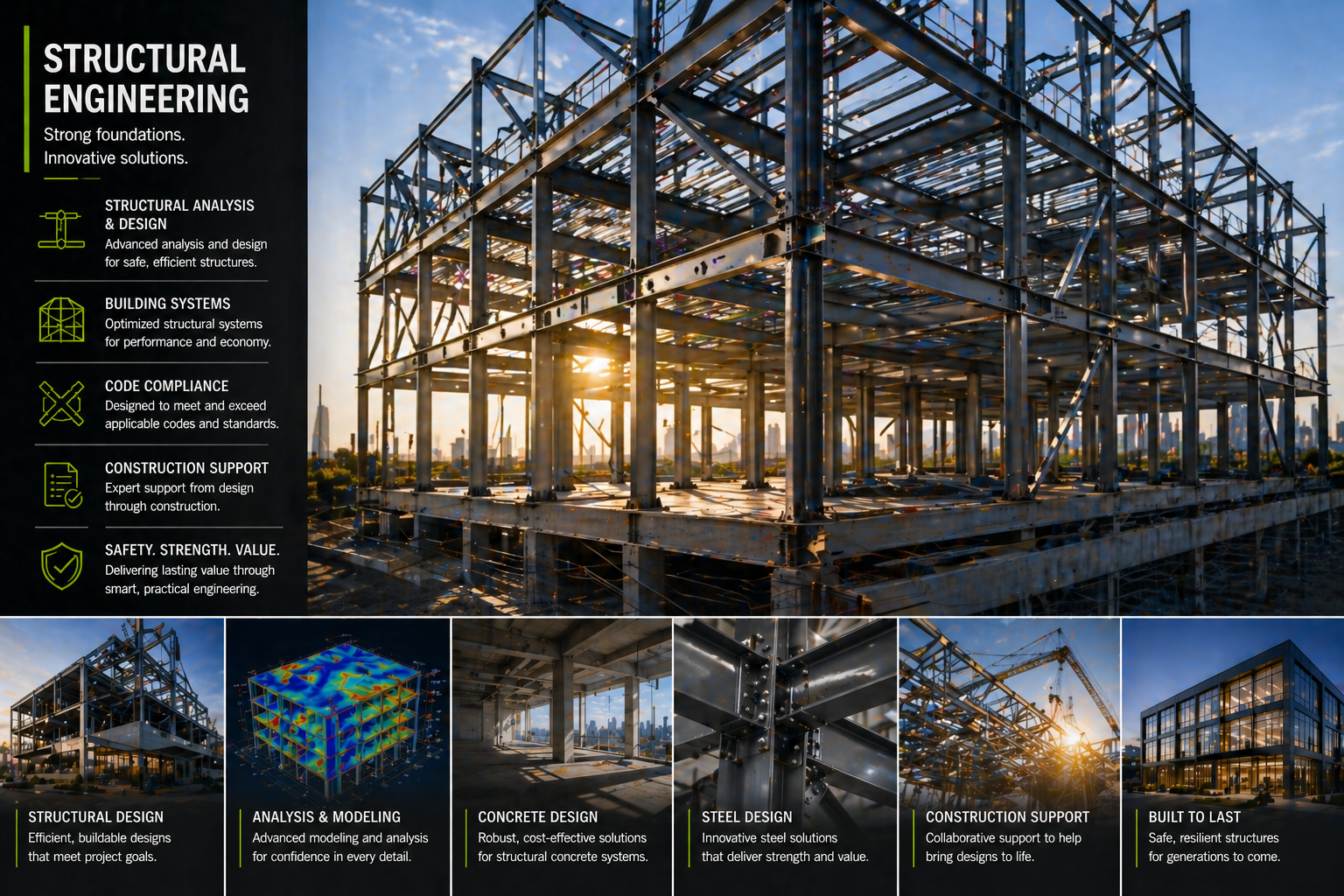
- Concrete structural design: Cast-in-place and precast concrete frames, post-tensioned slabs, shear walls, and foundations, specified for the regional ready-mix market and scheduled to the owner's pour-rate expectations.
- Steel structural design: Wide-flange, hollow-section, and cold-formed steel framing for commercial, institutional, and industrial buildings, with connection design, seismic detailing, and fabrication-friendly specifications.
- Wood structural design: Conventional light-frame, heavy timber, glue-laminated, and cross-laminated timber systems, with Part 9 and Part 3 code expertise and fire-resistance detailing for encapsulated mass-timber assemblies.
- Hybrid structural systems: Concrete-podium-over-wood, steel-braced-frame-over-concrete-core, and other hybrid configurations that unlock height, cost, or speed advantages where single-material systems can't.
- Foundation engineering: Shallow and deep foundation design, grade beams, mat slabs, pile caps, and screw-pile selection, with geotechnical coordination and site-specific settlement analysis.
- Industrial and oilfield camp design: Modular and site-built structural design for remote industrial camps, prefabricated kitchen-and-laundry modules, transport and lift analysis, and harsh-climate detailing.
- Renovation and adaptive reuse structural engineering: Load-path investigation, temporary shoring, structural openings through existing slabs and walls, and supplementary framing for change-of-use projects.
- Structural damage assessments: Post-fire, post-flood, post-impact, and post-settlement assessments, with remediation engineering scoped to the findings.
- Building inspections: Routine and pre-purchase structural inspections with engineering reports suitable for lender, insurer, and owner due diligence.
- Failure investigations: Root-cause analysis for structural performance failures, with reporting calibrated for the owner, the insurer, or the courtroom, depending on the destination.
- Sustainable and low-embodied-carbon structural design: Concrete mix optimization for reduced clinker content, mass-timber substitution studies, and whole-building life-cycle assessment coordination with the Sustainable Design team.
- Snow, wind, and seismic load analysis: Site-specific load development with current NBCC and provincial amendments, plus climate-forward load scenarios for resilience-focused projects.
- Structural peer review: Independent review of other firms' structural designs for owners, insurers, and public authorities.
- Construction administration: Shop drawing review, site reviews, non-conformance reporting, and substantial-performance sign-off.
Featured Projects

N.E.N.A.S. Addition
.webp)

4 Mile Corner Plaza
.jpg)
The Insignia